So I have announced that I am doing a Stitch-Along for our caskets starting in January and as part of that, I have been preparing information that I think might be helpful for everyone who has been in the Cabinet of Curiosities. My point is to make everyone who wants to make a casket (or mirror) get started and overcome whatever is in their way.
So today starts a series of helpful (hopefully) blogs that will lead you through decisions - some practical and some emotional. We all get stuck and paralyzed somewhere in the process of starting a project and it isn't the same for everyone. And this project is massive, can be expensive, is time consuming and effectively I have asked you to put what you know best aside and become a designer, so for many of you this is uncharted territory. I have to laugh as if it was grown women who did this in the 17th century - we might only have five examples to view in museums! Children are fearless and dive in...we need to emulate them to get started.
So I have been writing down all the reasons I hear from everyone (and myself) that starting is hard. For the next three days, our topic is "What Casket" should I get/do. We will then talk about the fear of failure, permission to enjoy ourselves and go into the design decisions to make so you can have linen on frames in January! I have prepared checklists and decision flow charts that will be posted on the class website soon - and am using pieces of them here in these blogs so you can reflect daily.
Which Casket?
 |
| Where will your piece live and does it fit? |
I think there are three major themes that drive everyone's choice of a casket and you have to decide which one of these themes is most important to you and then follow that decision flow chart. They are: What you will do with it, your budget, and does it fit your design concept. Today, I want to treat the easiest of them - what you will do with it.
The space inside the casket can be an easy way to convince yourself of which one you want to work. This is emotional and not practical - you have a dream or a scenario in your head of where this piece is going to live and what you are going to do with it. It is the adult version of the Barbie Dream House that you wanted so bad that one Christmas. So what do you envision?
Will you store your jewelry in it and use it daily? So you might want doors that can be ajar so you
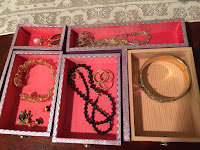 |
There are two levels of drawers like
this in the double casket
to give you a feeling of what will fit. |
can get to the small drawers easily. Put your needlework tools and threads inside as a workbox? So a big space is useful. Is it going to be a place that you put something highly personal or collectible inside? Or are you thinking of expressing yourself further in the box with an embroidered garden, a music box or some other creative idea?
Or, is your nose wrinkled right now. I am not touching it, you are thinking to yourself. No one is touching it! It is a museum object - damn it! I am putting it under one of those plexi cases to keep it from the dust and little lights trained on it and maybe if I don't will it to my favorite relative I will take it with me!
Well each of those use cases infers what kind of space is inside and can cut your decisions down to one or two options. Much easier to make a decision now! Take a look at this flow diagram and what kind of casket is recommended based on the use.
Yes, this is emotional and yes I mentioned ashes. Don't judge the person who wants to make their
 |
The contents of my stitching stuff
on my 'nest' table stuffed
into the drawers of a double
casket. Not much fits. |
casket a memorial to a special person or pet. And yes, I have seen this happen in a 17th century casket with modern ashes so I have an idea of what space is needed. Trust me.
And if you want it to live as a museum object in your home, where you might walk by it with your guests and serendipitously turn on a few lights to highlight your accomplishment... you will want the big one with all the bells and whistles. I give you permission.
You want it to be useful and have it near your stitching nest so you can enjoy it daily and use that excuse with the other partner in your checking book - then get the Short Casket - it is cost effective, has lots of room and won't drive you insane automatically locking every time you close the lid because it doesn't have a lock! (Just to clarify, the lid locks on those that have them click when the lid is closed, engaging the lock automatically, needing the key to open. You can gently place the lid ajar and open and close without a key - but if this is something that would drive you insane to have it lock or have it always ajar, take it into consideration).
 |
These are the tall drawers and some tubes of thread and my
glasses stick up over the side of the drawers |
And if you have a desired use sceniaro that isn't really listed here - let me know about it! I promise I won't laugh (and really, after seeing one used as an urn... there isn't anything you can tell me that will make me blink). I might be able to help you figure out which one would do the trick best.
Tomorrow - budget as a decision point.
 |
| Some mementos of the classes in my Flat Casket tray |
 |
The tray out of the Flat Casket and showing how much
extra space there is under it in the box |
 |
What fits in the bottom of the Flat Casket and the tray fits on
top of it. All of the packages of Soie Gobelin, Soie Paris, Soie Ovale,
and Soie Perlee in the class. |
 |
This is the Short Flat Casket. It has no tray and a smaller area to store things,
but I still get all the Soie Perlee, Soie Ovale, and Soie Paris in their bulky packaging inside! |
 The first thing to do if the design concept/story or technique is the most important factor to you is to make a list of everything you want on your casket. Then look at the list and divide it into major items and minor items. The easy way to think about that is to separate the ones that are to be in the background like trees, flowers, cats, castles, etc. and put those in the minor category. The figures like the characters, family members, etc. are in the foreground and they are the major items. Typically, only one major item will fit on a panel and the minor items will be used as the background fillers. You can have two to three on a large panel like the top of a Flat Casket or the back of a piece if you have some that relate in a scene of a story.


